What Is a Justin Jefferson Card Worth?
How to value any Justin Jefferson card: identify the exact card, match the grade, and read real sold comps. Live eBay listings and current auction bids — no made-up numbers.
Live Jefferson auctions — real current bids
LIVELive eBay listings · prices and bids as eBay shows them now · tap a card to open it on eBay
Browse every live “justin jefferson rookie card” listing on eBay →
There’s no single answer to “what’s a Jefferson worth,” because Justin Jefferson has hundreds of different cards across every Panini line — and the same card can be a common raw single or a serious chase piece once it’s graded. Rather than publish fixed numbers that go stale within a week, this page shows you live eBay listings and current auction bids, and walks you through pricing your exact card against the real market.
The prices you see on this page are live eBay listings and real current bids — not values we set. That’s the honest way to price a moving market.
Step 1 — find your card’s tier
Valuation starts with identification, not with a price guide. Figure out which tier your card belongs to, then use that tier’s page to narrow down the exact card and open the right live listings:
- Retail base rookies (Score, Donruss Rated Rookie, Prestige, Chronicles) — the highest-volume, most affordable 2020 cards. Start at cheap Justin Jefferson rookie cards.
- Hobby chromium rookies (Prizm, Optic, Select, Mosaic) — the flagship rookie market. See Justin Jefferson rookie cards, or the individual set reviews for Prizm, Optic, Select and Mosaic.
- Collegiate / LSU rookies — 2020 Prizm Draft Picks cards show him in an LSU uniform and price very differently from the NFL flagship. See the Draft Picks review.
- Rookie parallels — Silvers, colored parallels, and serial-numbered rainbow cards. See best Jefferson rookie parallels.
- Veteran-era parallels — his record-season and prime-year Prizm rainbow, a separate market from the rookie parallels. See modern Prizm parallels and the cards-by-year guide.
- Inserts — the design-driven chase lines (Kaboom!, Downtown, Color Blast and friends). See best Jefferson insert cards.
- Jersey, patch and relic cards — swatch quality drives everything here. See jersey, patch & relic cards.
- Autographs and RPAs — the top of the market. See Jefferson autographs, the Contenders Rookie Ticket review, and the National Treasures RPA review.
Not sure which 2020 brand you’re holding? The rookie card checklist lists every 2020 Panini brand that carries a Jefferson rookie, grouped by tier.
Step 2 — how to check a football card’s value
The same procedure works for any modern football card, not just Jefferson:
- Read the card front and back. You need the year, the brand/product name, the insert or parallel name, the card number, and any serial number (e.g. a card stamped out of a fixed print run). Panini prints most of this on the back.
- Separate flagship from lookalikes. Draft-product cards, retail-exclusive parallels and hobby parallels can share a design but not a market — the Draft Picks vs. NFL Prizm and Mosaic channel breakdowns cover the two traps that catch people most often.
- Be honest about condition. Corners, edges, surface and centering decide whether a raw card would grade high or low. Run the card through the card centering tool before you assume it’s a gem.
- Search the exact description on eBay. Year + brand + parallel + player, then add the grade if it’s slabbed.
- Filter to Sold Listings. This is the step most people skip. Active listings show what sellers are asking; sold listings show what buyers actually paid.
- Compare grade to grade only. A raw copy, a PSA 9 and a PSA 10 of one card are three separate markets — never average them together.
- Ignore the outliers and check the dates. One odd sale from months ago isn’t the market. A cluster of recent sales is.
- Write it down. Log what you own and what comparable copies are doing in the collection value tracker so you’re not re-researching the same cards every few months.
What drives Justin Jefferson card values
- Rookie vs. later years. His 2020 rookie cards carry a premium over most later base cards — though his record-setting seasons gave the veteran-era chase cards their own following.
- Scarcity and parallels. Base cards are common; Silver-tier chromium, colored parallels, serial-numbered cards and 1/1s climb steeply as the print run shrinks.
- Autographs and RPAs. On-card autos from premium products (Contenders, National Treasures) and rookie patch autographs sit at the top of the market.
- Memorabilia quality. For relics, a plain single-color swatch and a multi-color prime patch are not remotely the same card — see the relic buying guide.
- Grade. The single biggest lever. A gem-grade slab can be worth many multiples of a raw or lower-graded copy of the exact same card.
- On-field performance. As one of the NFL’s elite wide receivers, Jefferson’s market stays active and demand-driven, and it moves with the season.
What’s the most expensive Justin Jefferson card?
Structurally, the answer is always the same shape even as the record-holder changes: it’s a 2020 rookie-year, on-card autograph, low-numbered or one-of-one card — typically a rookie patch autograph from the premium end of the Panini catalogue — or a gem-graded copy of one of the scarcest chromium rookie parallels. The National Treasures RPA review covers that grail tier, and the autographs page opens live listings across it.
Because these cards trade rarely and in a wide band, any published “most expensive” figure is out of date almost immediately. The RPA and serial-numbered rails on this page are the reliable way to see where that tier actually sits today.
Grading is the biggest single lever
If you’re valuing a raw card, you’re really valuing two things: what it’s worth as-is, and what it might be worth slabbed. That gap is where most of the money in the modern hobby lives — and where most of the mistakes happen too.
- Work out whether submitting is worth it with the grading ROI calculator.
- Decide between graders with the PSA vs. BGS vs. SGC guide.
- If your card is signed, confirm the signature is legitimate before you value it — see how to spot a fake Jefferson autograph.
Four mistakes that produce wrong valuations
- Pricing against asking prices. Unsold listings can sit at aspirational numbers indefinitely. Sold comps only.
- Mixing grades. Averaging a raw sale with a PSA 10 sale gives you a number that describes no real card.
- Confusing the product. LSU/draft cards, retail-exclusive parallels and hobby parallels get mixed up constantly — and each has its own market.
- Assuming your raw card is a 10. Most aren’t. Check centering and surface honestly first.
New to the player’s card market? Start with the Justin Jefferson collecting guide, or browse everything on the Justin Jefferson player hub.
Use the live auctions and eBay buttons on this page to check what your specific Justin Jefferson card is actually selling for right now.
Find these cards on eBay
The cards on this list trade on eBay, not Amazon — these open live listings for each one. Buy graded (PSA or SGC) for anything above four figures.
Products Featured on This List
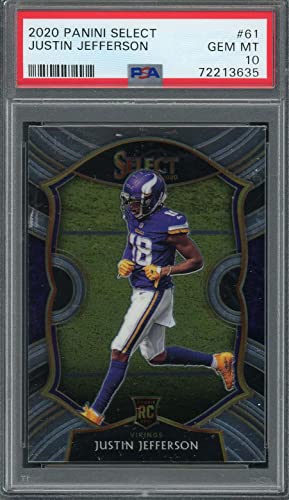
Justin Jefferson 2020 Select Rookie Card RC #61 – PSA 10 Graded (Cert #72213635) Gem Mint Authenticated by Powers Sports Memorabilia | Justin Jefferson Football Card
1 owner reviews
Justin Jefferson 2020 Select Rookie Card RC #61 – PSA 10 Graded (Cert #72213635) Gem Mint Authenticated by Powers Sports Memorabilia | Justin Jefferson Football Card.
![Custom Printed Business Cards [2-Sides] Thick Personalized Cards (300GSM 14PT) 3.5" x 2" [100% Printed in the USA] Premium Front & Back Sides (Customizable) (x100 Pack)](https://m.media-amazon.com/images/I/41+A754xHvL._SL500_.jpg)
Custom Printed Business Cards [2-Sides] Thick Personalized Cards (300GSM 14PT) 3.5" x 2" [100% Printed in the USA] Premium Front & Back Sides (Customizable) (x100 Pack)
1,428 owner reviews
Custom Printed Business Cards [2-Sides] Thick Personalized Cards (300GSM 14PT) 3.5" x 2" [100% Printed in the USA] Premium Front & Back Sides (Customizable) (x100 Pack).

2020 Score #430 Justin Jefferson LSU Tigers Rookie Football Card
6 owner reviews
2020 Score #430 Justin Jefferson LSU Tigers Rookie Football Card. An individual Justin Jefferson trading card for your collection.
- Individual trading card
- Add to your collection